
NASA, JAXA Reaffirm Cooperation in Space Exploration
Author: NASA
3 min read
NASA and the Japan Aerospace Exploration Agency (JAXA) will work together on three groundbreaking science missions to explore the moons of Mars, further study the atmosphere of the Sun, and research dark matter and the evolution of the universe.
In a Sept. 21 (ET) press conference at JAXA Headquarters, NASA reaffirmed that it will continue to strive for breakthrough science discoveries by cooperating with JAXA on Martian Moons Exploration (MMX), the Chromospheric Lyman-Alpha Spectro-Polarimeter experiment (CLASP-2), and the new X-ray Astronomy Recovery Mission (XARM).
“From its inception, NASA’s mission to unravel the secrets of the universe has included efforts to engage in international partnerships,” said Thomas Zurbuchen, associate administrator of NASA’s Science Mission Directorate in Washington. “Today we reaffirm a cooperative endeavor that stretches back nearly six decades and spans across disciplines that include Earth science, human spaceflight, interplanetary probes and astronomy.”
> SYSTEM LOG // ENTRY 97783
> CATEGORY: MARS
> PUBLISHED: 2017.09.21_1325Z
> ASSETS_ATTACHED: 04
> SOURCE: NASA.GOV/WP-JSON
At an earlier meeting at JAXA’s Institute for Space and Astronautical Sciences (ISAS) in Sagamihara, Kanagawa, Zurbuchen agreed to explore options for NASA’s contribution to the MMX mission, such as a neutron and gamma-ray spectrometer. Scheduled to launch in the early 2020s, this JAXA-led mission will orbit Mars and visit its moons Phobos and Deimos to take remote sensing and in-situ observations of both moons, returning a sample from Phobos. The goal of the mission is to reveal the origin of the Martian moons and to further understanding of solar system formation.
In the field of solar physics, both agencies plan to cooperate on a follow-on mission to the Chromospheric Lyman-Alpha Spectro-Polarimeter, or CLASP experiment, which obtained observations during its launch on a sounding rocket in 2015. CLASP-2, led by NASA’s Marshall Space Flight Center in Huntsville, Alabama, will build on the success of its predecessor and study the magnetic field in the chromosphere and transition region of the Sun’s atmosphere. The experiment is planned to be an international effort, with contributions from the U.S., Japan, Spain and France. Japan plans to provide internal structure and optics for the instrument.
Both agencies also will work toward a new X-ray Astronomy Recovery Mission (XARM), with NASA’s Soft X-ray Spectroscopy onboard. This NASA-JAXA collaborative mission – with European Space Agency (ESA) participation – will investigate the structure and formation of the universe using high-resolution spectroscopy. XARM would replace the Hitomi X-ray spectrometry spacecraft, which launched in February of 2016 but malfunctioned weeks later. XARM is designed to provide breakthrough results in scientific areas as diverse as the large-scale structure of the Universe and its evolution, the behavior of matter in the gravitational strong field regime, the physical conditions in sites of cosmic-ray acceleration, and the distribution of dark matter in galaxy clusters.
NASA and JAXA will continue to cooperate on the Venus Climate Orbiter Akatsuki, as well as on the Hisaki (SPRINT-A) ultraviolet astronomy satellite, with plans to analyze the scientific data obtained. The agencies also reaffirmed their intent to exchange specimens from the OSIRIS-REx and Hayabusa 2 asteroid sample return missions, a plan codified in a NASA-JAXA Memorandum of Understanding signed in 2014.
“Space exploration is a team sport and an opportunity to advance international cooperation to benefit all of humankind,” said Zurbuchen. “While these missions promise a strong platform for partnership in the next decade, we will continue to exchange information and explore opportunities further on the horizon to explore the solar system and beyond.”
Discover More Topics From NASA
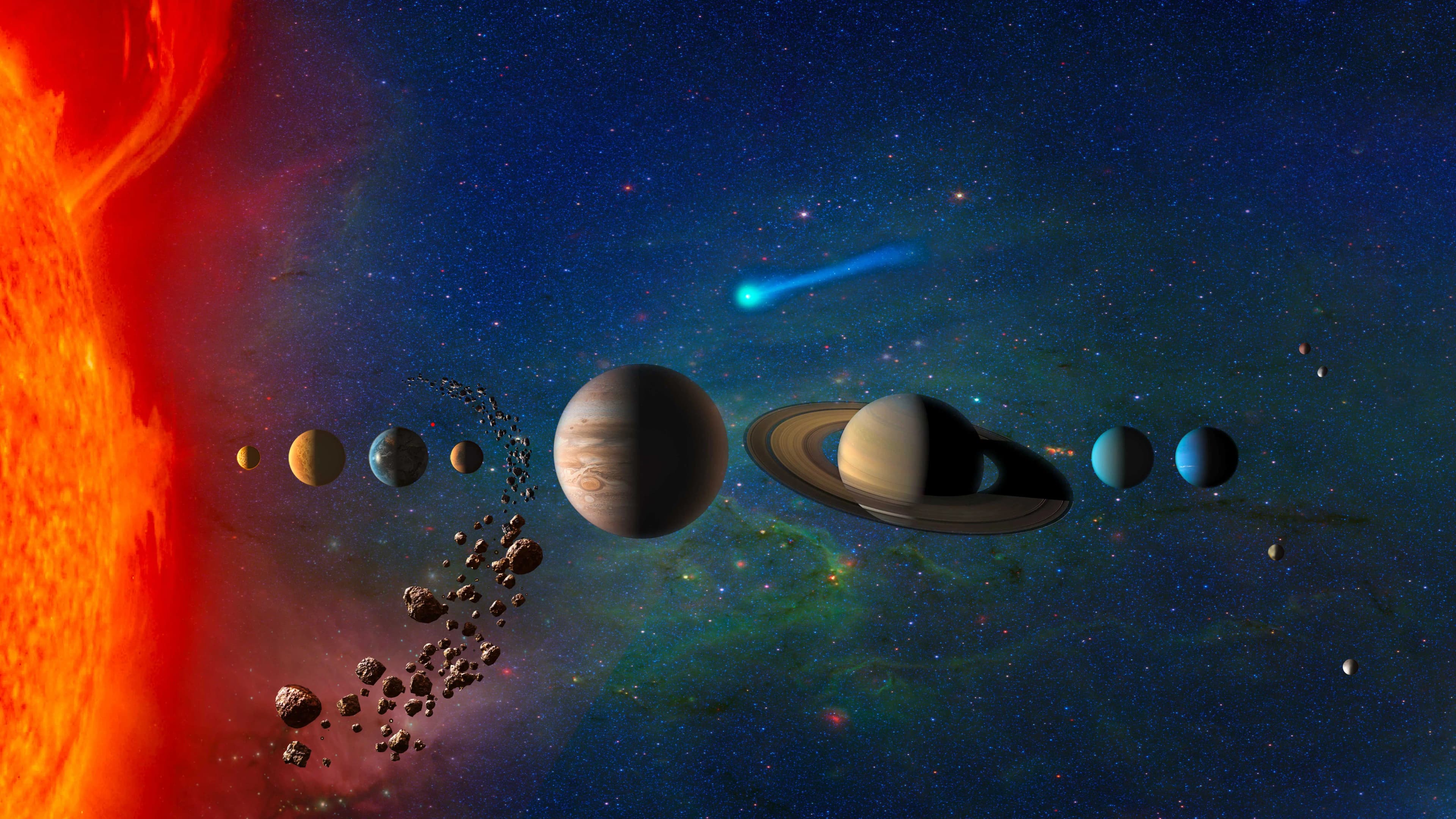
Our Solar System
Overview Our planetary system is located in an outer spiral arm of the Milky Way galaxy. We call it the…
Mars
Mars is the fourth planet from the Sun, and the seventh largest. It’s the only planet we know of inhabited…
Asteroids, Comets & Meteors
Overview Asteroids, comets, and meteoroids are chunks of rock, ice, and metal left over from the formation of our solar…
 SRC: SOLAR-SYSTEM-ILLUSTRATION-16X9-1
Fig 01
 SRC: 7668_MARS-VIKING-2-ORBITER-GLOBAL-VIEW-PARTIAL-VALLES-MARINARES-PIA04304-FULL2
Fig 02
 SRC: CHRISTY-TURNER-WITH-COMET-NEOWISE-800
Fig 03
 SRC: BENNU-BANNER-1920X640-1
Fig 04